
Produced by Transatlantic Records in 1962, this was the first Dubliners record that the Dubs themselves had to their own. It was produced by Nathan Joseph of Transatlantic Records, a famous record company headquartered in London. It was recorded at Livingston Recording Studios in London in front of a small audience.
Tracklist
Tom Leader aged 5, was talking to the roadsweeper. Four Irishmen emerged from a house nearby "They look like 4 nannygoats", said the Roadsweeper". "No", said Tom, who had heard them sing. "Nannygoats have horns".
Ciaron Bourke, Barney McKenna, Ronnie Drew and Luke Kelly have beards. Barney's is big, black and bushy and Barney is big, giving an overall Impression of a benign Californian black bear. Barney plays the banjo with a dexterity unmatched by anyone else In Britain. Ronnie Drew's beard is still blacker than Barney's, but smaller and trimmer. It encircles his face in such a way that his eyes resemble a cat's peering out of a coal cellar, or a devil glaring out of hell. Ronnie plays guitar and sings in a voice like coke being crushed under a door. Ciaron's beard is lighter in colour and straggles a little. The hair is not so wiry either. Ciaron is the quiet member of the group. He plays the whistle and his voice has a softer texture than Luke's or Ronnie's. Luke has a smart, sharp ginger beard. The others accuse him of being an Intellectual. He is more lone wolf than nannygoat. He sings in a voice to wake the dead and scare recording engineers, and plays the banjo.
Together as the Dubliners, they are enough to warm the heart of any Irishman and to frighten the British immigration authorities. They are Dublin's darlings; impossible for an audience to resist and impossible to record. We recorded them.
Nathan Joseph
In The Ragman's Ball, you have in Ronnie Drew the finest exponent of Dublin type ballad singing. The loop-line porter mentioned was a slang term for cheap porter sold in Brady's pub In Ash Street.
Preab San Ol is an old Irish drinking song which was translated by Donald O' Sullivan. Its philosophy appeals particularly to Irish people-since you can't take money with you, you might as well drink it.
The High Reel is a fine example of a Scottish reel which came to Ireland and was much enhanced with Irish grace notes and decorations. Barney uses a lot of trick playing when he plays this reel.
In Cobh, Co. Cork, where Transatlantic Liners dock, there is a spot called The Holy Ground where sailors enjoyed themselves while ashore. It was Luke who collected the next song, Tramps and Hawkers while singing with the group in Scotland.
The last song on this side Home Boys Home has a moral for all tardy women. There are many versions of this song.
The Rocky Road to Dublin is a slip jig and is really our signature tune. It was collected by Colm O'Loughlin.
The Banks of the Roses, a love song, is sung a lot In Ireland.
I'll Tell My Ma, is a Dublin Children's skipping song and is sung universally by children.
Barney got the next song The Swallow Tail Reel from Sonny Brogan, an old Dublin accordian player.
While travelling around Ireland Ciaron collected verses of the blackguarding song The Jar of Porter.
We finish the record with The Nightingale which, like "Home Boys Home" has a little moral for women on the wiles of men.
Ciaron Bourke
For a first album, this is spectacularly good--but when you consider the other albums that the Dubs were later to make, it is pretty mediocre. Recorded by folk recorder Nathan Joseph, in London, the album was produced by Transatlantic Records. The Dubliners were yet to find their "signature sound", and due to it being recorded live, the sound can be a bit simple or "tinny" to some ears. The distinct lack of violin is fairly evident, and it gives the recordings a simple, unproduced, yet charming quality to them. Songs like The Rocky Road to Dublin and Come All Ye Tramps and Hawkers are simply superb (due to Luke's fantastic diction and delivery), whilst songs like Love is Pleasing and Jar of Porter fall short when compared to those headed by Luke. For a first album, this is pretty good; but it is simply nothing when compared to what was going to come
Back Home------------------------------------------------------------------------------------------------------------------------------------------------------------------------------------------------------------------------------

By 1964, Luke Kelly had left The Dubliners, and was pursuing a solo career and playing with the likes of Ewan Maccoll, Pete Seeger and Tommy Makem, and as such 2 new men came for Luke's place. The first, was a young 25 year old Electricity Board Workman and adept fiddle player called John Sheahan, the 2nd was a young fine singer and balladeer, Bobby Lynch; who played the guitar. The fiddle brought a new, unique sound to the Dubs, which had been missing in their first album. The album was recordewd in front of an audience at Cecil Sharp House, in London.
Tracklist
December 4th was D. Day, Dubliners day. They flew in, dashed from London Airport to the B.B.C. T.V. Studios, recorded three spots for the "Tonight" show and then rushed across London by taxi for a pre-concert conference. There, we ironed out their programme and went over some recording details. By that time the audience were pouring into Cecil Sharp House, the traditional home of British Folk Music, the engineers were chewing their fingers and Roy Guest, who organised the evening for E.F.D.S.S. with Transatlantic Records was itching to get the performance under way.
The Dubliners have not visited England often in the past two years and much has happened to them in that time. The packed audience was full of excitement and expectation. Since they first burst onto record (TRA 116) the group has lost Luke Kelly and gained two newcomers John Sheehan and Bobby Lynch, neither of whom had been seen in England before. In the past 12 months the boys had become Ireland's best-ever selling recording artists with their L.P. "The Dubliners", their E.P. "In Person" and the single "Wild Rover/Rocky Road to Dublin". They had achieved unparalleled popularity on TV in Ireland and played everywhere to sell-out houses. Through records too, their fame had begun to spread to America, Australia, and New Zealand. For the artists and the recording company this was a nail-biting one-shot effort. The results had to be good for the boys weren't due back in England again until May. In the event I think everyone was satisfied. The audience, as you'll hear went wild with delight. The Dubliners turned in an electrifying and typically warm and spontaneous performance and the recordings have captured admirably the spirit and atmosphere of the occasion.
Nathan Joseph
Roddy Mac Corley was known as the Kevin Barry of the North; he died at the old wooden bridge at Toom Bridge very near Belaghy, Co. Derry, a place which is very republican to this day.
The Twang Man. This is a Dublin slang song which Ronnie learned from his father. "Hawking twang" means bartering home-made toffee: a Mot is a woman-wife, sister, sweetheart or whatever.
Reels-The Sligo Maid. Colonel Rodney. The first is a very popular tune in Dublin and was learned by John at the Fiddlers Club, Church Street. We might as well admit that we do copy the Clancy's-they have Tommy Makem to carry them home from drunken sessions, so we get John Sheehan to carry us home. In his spare time John plays the fiddle.
Seamus Ennis was the first man we heard singing The Woman from Wexford. There are numerous versions of this song on the theme of "Blind Man He Can See." a theme also very popular in medieval literature.
The Patriot Game. Bobby, who takes this solo, was playing around Dublin for about a year and joined us on so many sessions that he stayed-somewhat like Topsy we just growed!
"Lead me to the spot where lies my son, He of the ruddy glow and sunny cheek, Let me sadly gaze upon the lips that ne'er again shall speak. Oh shame the cowards who so shamely stole the keep. Seventeen years were all the years he ever lived, my little boy, Now an ugly yoke and lid shall be the coffin for my heart's first joy. Oh shame you cowards that did a child destroy."
Domnic Behan wrote these lines after the burial of Fergal O'Hanlon, who died in an attempt to banish a border that still exists between Northern and Southern Irish Men; later he developed the lines to the ballad, The Patriot Game, which was to become world famous.
Roisin Dubh. Barney, as you may have guessed, comes from a very musical family and probably heard "Rakish Paddy" from his uncle before he heard the conventional Mama and Dada bit. Although he plays a variety of instruments his main ones are the tenor banjo and mandolin. Here with John he plays Róisín Dubh or "My Little Black Rose" which is an allegorical ballad-the rose being Ireland.
Air-La La La Lo was learned from the singing of Ray and Archie Fisher. The song itself tells more than anyone could write about it.
Peggy Lettermore, the only Gaelic song on this record, is sung by Ciaron. who learned Gaelic as soon as be learned English. He helps to keep both Gaelic and drinking up to scratch with the help of people like Seamus Ennis and Joe Heaney. The song is in praise of a girl called Peggy who came from Lettermore Island in Connemora.
Easy and Slow is a song which we first heard from various members of the Behan family in Dublin pubs.
My Love Is In America is one of Barney's showpieces. There is little doubt that he is one of the finest banjoists in the world
Seamus Ennis was the first to make The Kerry Recruit popular. We learned it from him and then adapted it to the Dublin style.
In The Old Orange Flute we give a bit of lighthearted blackguarding in which the flute gets the better of Orange Men and Papishes alike.
The Donegal Reel and The Longford Collector. We played the second reel outside the Church at Ronnie's wedding and we have since renamed it, "Ronnie's Wedding."
Leaving of Liverpool. Luke Kelly, who appeared with us on our first record, was the first to make this song popular in Ireland
The Dubliners
A good record, not as good as the first, or the records that are to come, but still worth a listen. Bobby Lynch performs spectacularly well, and it is a shame that he left when Luke Kelly came back. John Sheahan is an excellent fiddler in this record as can be heard, and most of the songs hold up very well.
------------------------------------------------------------------------------------------------------------------------------------------------------------------------------------------------------------------------------

By 1965, Bobby Lynch had left The Dubliners and Luke Kelly was back, and John Sheahan stayed. This was the first record that had the definitive lineup of The Dubliners. It was recorded at The Gate Theatre in Dublin on the 26th and 27th April 1966, by Nathan Joseph of Transatlantic Records. It consists of a very good version of The Hot Asphalt and The Dublin Fusiliers, sung by Luke Kelly and Ciaran Bourke respectively.
Tracklist
Finnegan's Wake (Ronnie)
Hornpipes: The Sunshine Hornpipe & The Mountain Road (Barney)
Monto (Luke)
The Dublin Fusiliers (Ciaran)
Hornpipe:- Chief O'Neill's Favourite (Barney)
The Sea Around Us (Ronnie)
McAlpine's Fusiliers (Ronnie)
Hot Asphalt (Luke)
The Glendalough Saint (Ronnie)
Reel:- Within a Mile from Dublin
Will You Come To The Bower (Luke)
Nelson's Farewell (Ronnie)
The show, "Finnegan Wakes", at the Gate Theatre Dublin, ran in the spring of 1966 to packed and enthusiastic houses. From the show, we have taken for this record some highlights of the Dubliners' performances. In a later LP we hope to issue some of the many other wonderful items from the show, including the work of other artists who took part. We wish to thank the management of the Gate Theatre and Mr. Michael Geoghehan of Irish Record Factors, Dublin, for their invaluable assistance.
The Dubliners are Luke Kelly, Ronnie Drew, Ciaron Bourke, Barney McKenna and John Sheahan
Better than the 2nd album, and with a very good version of the Hot Asphalt headed by Luke, also consisting of a lovely version of The Dublin Fusiliers by Ciaran. A good album.
------------------------------------------------------------------------------------------------------------------------------------------------------------------------------------------------------------------------------
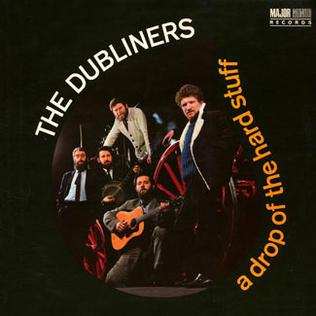
This album, released in 1967, was the first studio album that The Dubliners ever produced. By then, they had left Transatlantic Records and were now with Major Minor Records, a promiment folk company.
Back Home