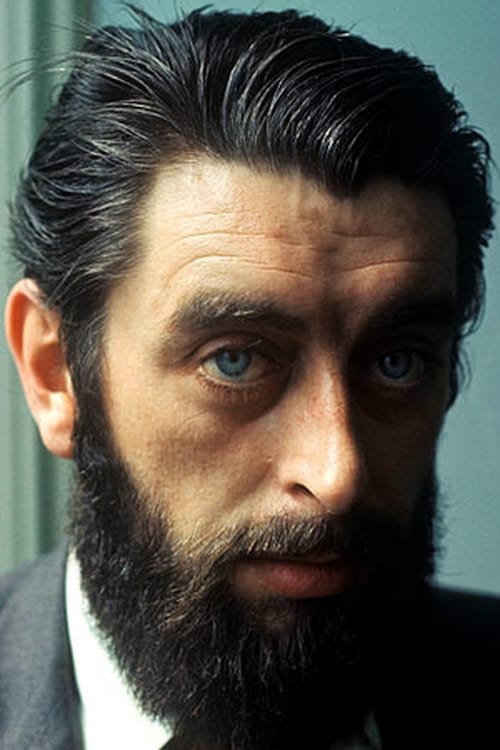
Ronnie Drew born Joseph Ronald Augustine Drew on the 16th September 1934 in "Beaufort", Glasthule, Dun Laoghaire, Dublin, to ballroom dancers Paddy Drew (d. 1984), and Margaret "Peg" Drew, nee Maher. When very young, he lived at 37 Oliver Plunkett Avenue in Dun Laoghaire, and when he was aged 3, his was sent to live with his maternal gransparents at a posh house at Tivoli Terrace, in Dun Laoghaire. At this point, his father became a carpenter, and Ronnie himself became (as Ronnie said himself) "a spoiled brat."
He was educated at St Joseph's School, and later CBS, Eblana Avenue, Dublin. In the late 1950s, Ronnie went to Seville, Spain to become a teacher of English. Whilst in Spain, Ronnie became fluent in Spanish, and at some points, lived with a timid young singer called Sean Cannon--Sean would later become part of The Dubliners. Whilst in Spain, Ronnie became proficient and learnt the Flamenco guitar, and learnt Spanish songs such as "Ojos Negroes" among others. In 1962, Ronnie returned to Ireland, and started to work at the Dublin Telephone Exchange. At this time, Ronnie decided that the pay was not enough for him, and started a business where he wouls sing, and tell tales and stories after a ceremony (wedding, funeral etc. etc.). At this time, a showman called John Molloy of The Gaiety Theatre in Dublin found Ronnie singing songs after a funeral, and he decided to hire Ronnie as a warmup act for his shows. Soon, a young banjoist called Barney McKenna joined Ronnie, and they were appearing at Fleadh Ceoils alongside 2 other men--Ciaran Bourke and Luke Kelly.
Soon, these 4 men decided to get together in O' Donoghues Pub in Dublin, and there the Ronnie Drew Ballad Group (one time credited as The Ronnie Drew Ballet Group!), decided to get together and sing songs. They were later known as The Dubliners. In The Dubliners, Ronnie was famed for his (at first) nasally voice, which got incremently more gravely and deep as years passed. His blue eyes, beard and voice made him instantly recognisable in The Dubliners, and became one of Ireland's most famous singers alongside Luke Kelly. Ronnie was famous for singing songs such as:- Dicey Reilly, McAlpine's Fusiliers, Finnegan's Wake (his favourite song) and 7 Drunken Nights, along others.
Ronnie left The Dubliners after Ciaran suffered 2 brain aneurysms in the 1974, and Jim Mccann took his place. Ronnie returned to The Dubliners in 1979, before leaving again in 1995 to pursue a solo career. Whilst solo, he did many gigs just by himself (occasionally alongside other Irish musicians), and he also recorded various solo albums as well.
Personal Life
Ronnie married Diedre Mccartan (the daughter of Patrick Mccartan) in 1963, Diedre died in 2007. Ronnie had a great interest in horse racing and sports, and owned many horses. In 1979, Ronnie broke his hip whilst riding a horse, which caused him to use crutches for a couple of months. In 2006, Ronnie was diagnosed with throat cancer. Ronnie lost his hair due to chemotherapy and remarked that he looked like "Nosferatu", but he bore his illness with acceptance and strength. A song in aid of the Irish Cancer Society was recorded for Ronnie (The Ballad of Ronnie Drew), which had a number of famous Irish musicians. Ronnie Drew died on the 16th August 2008 at St. Vincent's Private Hospital in Dublin. His funeral was on the 20th Augsut 2008, and he was buried alongside his wife at Greystones Cemetery.
Instruments
Discography
Is it the way the old masters painted it --
Floating on a damp cloud
In the company of winged creatures
Listening to non-stop harp music?
I could paint you in,
But not your expectations:
"Would somebody for Christ's sake
Get me down from here and show me
The fountain of champagne -- I thought this
Was meant to be a celebration!"
I'll paint a different picture instead:
I see your spirit, freed at last
From earthly shackles,
Soaring to a new consciousness --
Communicating with Kavanagh
Without the encumbrance of words;
Without the embarrassment of being barred
From four Baggot Street pubs.
All is clear now.
Ulysses simpler than the Lord's Prayer,
Beckett no longer waiting for Godot,
And Joe O'Broin sidling over
With an impish grin:
How'rya Ronnie, you brought me fame at last.
I heard Cliodhna and Phelim picked me poem
For the end of your mass,
But you needn't have hurried ...
There's no closing time up here --
Just one continuous holy hour"
Now Deirdre comes into focus,
Bridging a painful gap of fourteen months.
Unhindered by bodies,
Your spirits embrace and entwine
In a never-ending spiral of joy,
Leaving behind the three great imponderables That tortured you:
'What is life?'; 'What is art?'
And 'Where the fuck is Barney?'!